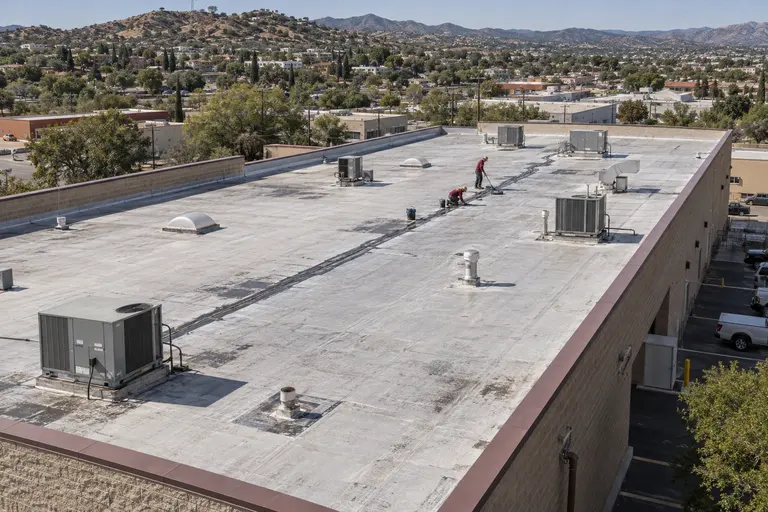
Flat Roof Repair
Base flashing, corners, and laps along the parapet repair with membrane matched to the roof.
Repair the flat roof
Tubac commercial roof repair for parapet-walled shop buildings, where water leaves the roof through wall scuppers that pack with leaves, dust, and storm debris.

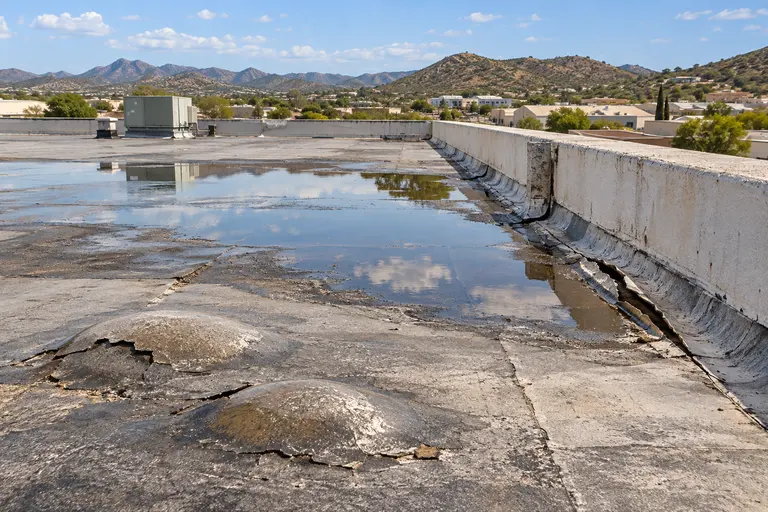
Many Tubac shops are low flat roofs boxed in by parapet walls. Water leaves through scuppers cut through those walls, so a packed scupper turns the roof into a shallow pond after a monsoon storm or a windy fall week.
Standing water then finds the weakest lap or the base flashing along the wall. The repair clears the scupper, reseals its through-wall flashing, and rebuilds the membrane wrap around the opening.
Parapet roofs leak where water collects against the walls. These rows start with what shopkeepers notice.
A through-wall scupper packed with leaves and dust, so the roof drains slowly or not at all.
Clear the scupper, check its box, and reseal the flashing where it passes through the wall.
Cracked coping joints on top of the parapet letting water run down inside the wall.
Seal or replace the coping joints and the cap so the wall top sheds water.
Base flashing pulled away from the parapet, opening the joint between wall and roof.
Refasten and repair the base flashing, then reset the counterflashing over it.
Inside corners of the parapet where membrane folds have cracked from heat cycles.
Install preformed or field-built corner patches tied into both walls.
An interior drain with a strainer packed by the same leaves that fill the scuppers along the walls.
Clear the strainer, reset the clamping ring, and check the drain flashing for splits.
Monsoon gusts sweeping leaves and grit into the same low corner every summer.
Clear the corner and add the spot to your spring and fall roof walk list.
Small parapet roofs in Tubac protect shop interiors, art, and stock from water coming off the walls.
Water that gets into a parapet wall shows up on interior plaster and displays. Sealing the cap keeps it out of the wall.
Clearing scuppers ends the standing water that ages membrane and soaks seams along the wall base.
Roof repairs that match existing materials keep visible changes small, which keeps historic zone review straightforward.
Coping and counterflashing repaired early save the stucco or plaster on both faces of the parapet.
Parapet roofs in Tubac usually need flat roof repair, or leak tracing when the water shows up far from the wall.
Base flashing, corners, and laps along the parapet repair with membrane matched to the roof.
Repair the flat roof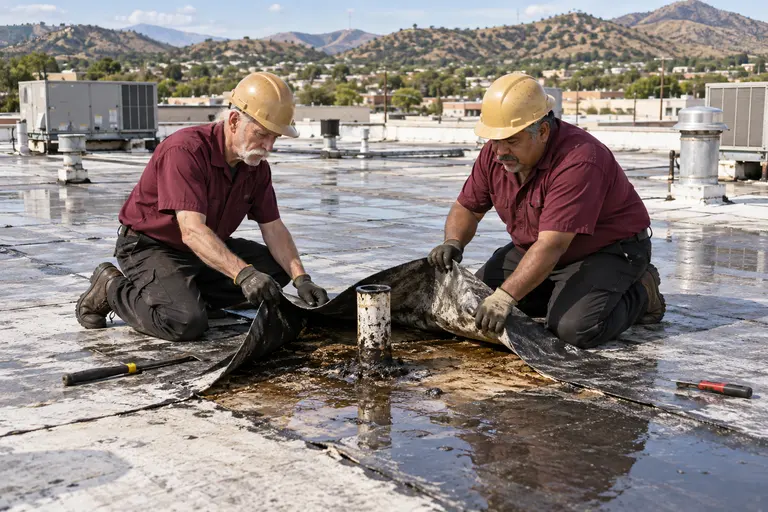
Water inside a parapet wall can travel; tracing confirms whether the cap, the scupper, or a lap feeds it.
Trace a wall leakA packed scupper can turn a small roof into a pond after one storm. Call and we will clear and check it.
Shops stay open below while the wall-top and scupper work happens above. Inspect Your Roof comes first.
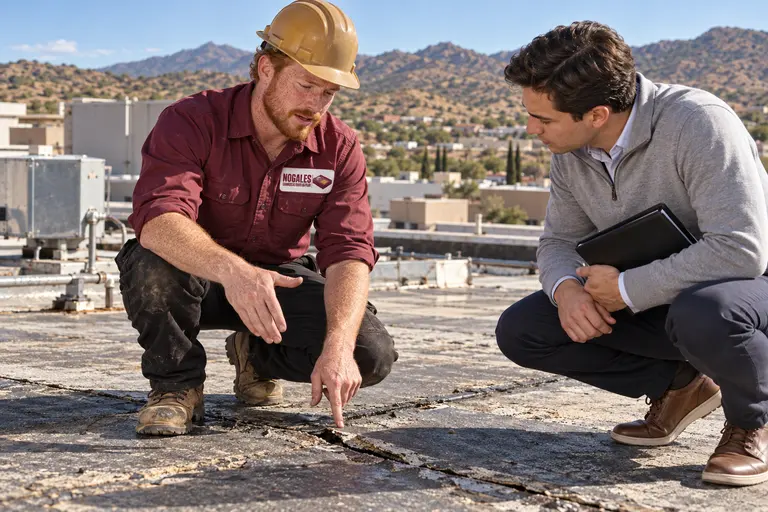

We check each scupper, the coping along every wall, and the base flashing, and look for ponding rings near outlets.
Any roof or parapet change visible from the street gets noted so historic zone review can be checked before work starts.
Debris comes out, the scupper box gets inspected, and the through-wall flashing is resealed.
Coping joints and caps get sealed, and loose base flashing is refastened with new counterflashing above it.
Inside, the plaster and ceiling along each repaired parapet get checked after rain, with photos sent to you.
Each neighbor has its own roof problems and permit office.
Farm buildings with exposed screws and rust.
County-line parcels along I-19.
Cold storage roofs crowded with condensers.
Main street storefronts on SR 82.
On Tubac parapet roofs, look first at scuppers and drains packed with leaves and grit, then at peeled edge metal or coping and torn membrane at corners. Inside, check for new ceiling stains. Arizona thunderstorm gusts nearly always pass 40 mph, according to the National Weather Service in Tucson.
Visible changes in the Tubac historic zone go to the county's Tubac Historic Zone Advisory Board. Repairs on a flat roof hidden behind parapets rarely change anything visible; parapet caps and coping that show from the street get more attention.
Tubac is unincorporated, so larger roof work runs through the Santa Cruz County Building Department, with historic zone review added for visible changes.
At least on the spring and fall roof walks, and after any storm that drops leaves or grit. Scuppers near trees fill faster.
Cracked coping joints or a loose cap let water into the top of the wall, and it runs down inside before showing as peeling plaster or a stain near the floor.
Changing a through-wall opening changes the wall and drainage design, so it goes through the county and, where visible, historic review. Most slow scuppers just need clearing and new flashing.
Indirectly. Leaves and seed pods collect in scuppers and drains, and water then stands against the parapet until it finds a weak lap. Trimming branches back from the roof and clearing outlets on each roof walk prevents most of it.
Joints between cap sections get cleaned and sealed, loose caps get refastened, and damaged sections get replaced with matching metal or masonry caps.
Tell us where water collects on the roof or shows inside the wall.
Leave a name and number and we will call you back about the leak, the seam, or the panel that has you worried.
Or call now: +1 (623) 310-0172