Commercial Metal Roof Repair
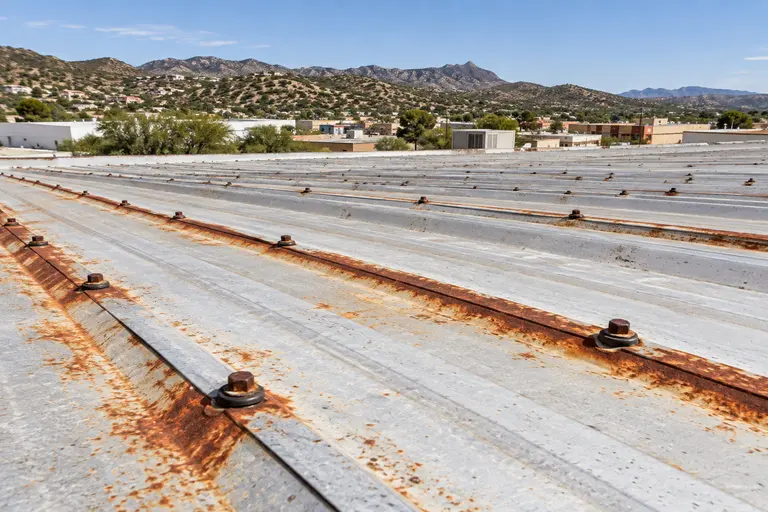
Metal sections of a plant roof need fastener, lap, and rust work alongside the curb repairs.
Repair metal roof sections
Industrial roof repair in Nogales for plants, packing houses, and cold storage: curbs, penetrations, and exhaust areas, scheduled around production and shipping.

Industrial roofs near the Mariposa Port carry condensers, exhaust fans, and process vents, and leaks cluster at those curbs. Most of that work is repairable.
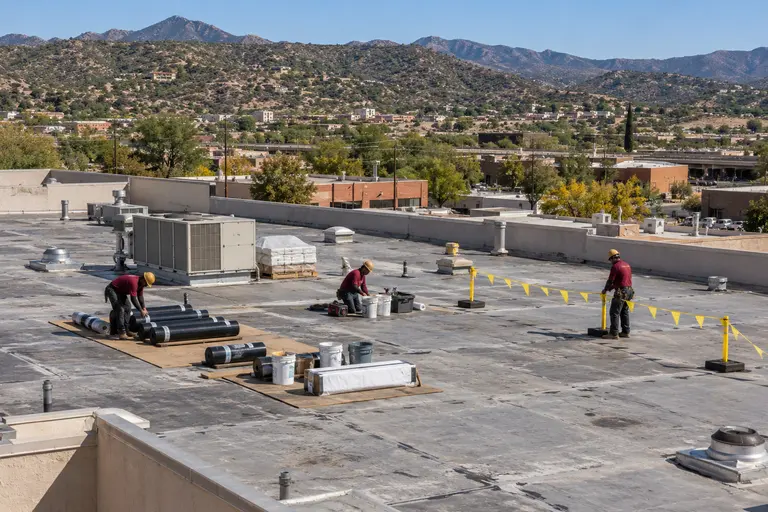
Equipment-heavy roofs fail around the things bolted to them. These are the patterns we see most on plant and cold storage roofs.
Condenser curb flashing split at the corners, often where refrigeration techs kneel during service.
New curb flashing tied into the membrane, with protection pads at the service side.
Membrane softened by heat or residue at the exhaust outlet, then cracked as it cooled.
Cut out softened membrane and install a material rated for the exposure.
Pipe penetrations with cracked boots or empty pitch pans where lines pass through the roof.
Replace boots, refill pitch pans, and flash each penetration into the field.
Service crews wearing through the membrane on the same routes to and from equipment.
Patch the worn route and set walkway pads so traffic stays on protected surface.
Cracked skylight curbs or panels on large plant roofs, often near ductwork supports.
Reseal or replace the skylight panel and repair its curb flashing.
Each repair gets planned with your facility team so production keeps moving.
| Repair | What It Fixes | When It Is The Right Call |
|---|---|---|
| Curb flashing rebuild | Split corners at condensers and fans | Leaks show under rooftop equipment |
| Penetration flashing | Cracked pipe boots and pitch pans | Drips follow process piping or conduit |
| Exhaust area repair | Membrane softened by heat or residue | Damage stays near the outlets |
| Walkway pads | Membrane worn along service routes | Repeat punctures follow the same path |
On a plant roof, the repair protects production as much as the roof itself.
Repair work happens on the roof surface, so coolers, docks, and produce lines keep operating while curbs get flashed.
Water that gets past a fan curb lands on whatever sits below. Flashing that curb protects the machinery and wiring under it.
Walkway pads along the routes refrigeration and HVAC techs walk end the punctures that keep reappearing.
Work gets scheduled around receiving and shipping, so trucks at the docks are never waiting on the roof crew.
Call and tell us what sits under the drip. We plan the temporary seal around your operation.
Two lanes run together: the roof work, and the coordination that keeps the plant going. Inspect Your Roof comes first.
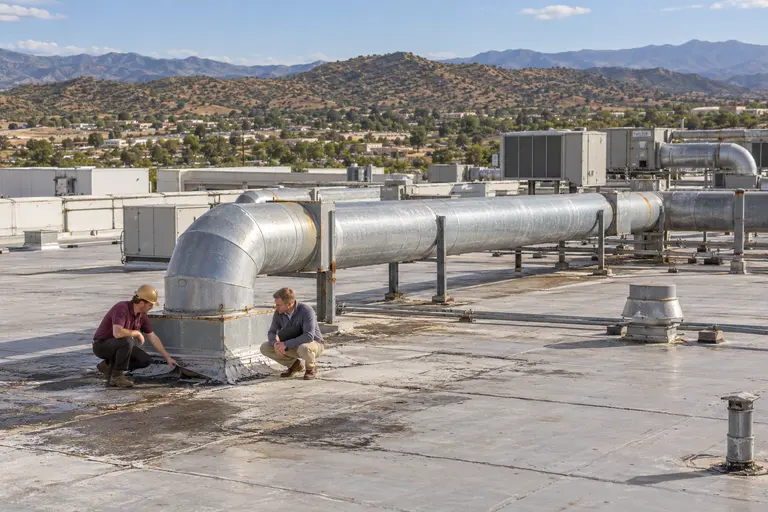
We map every curb, penetration, exhaust outlet, and walkway on a roof plan and note which ones are wet or worn.
Roof work windows are matched to shipping, receiving, and production, and any fan that needs to stop gets scheduled.
Any heat or flame work near exhaust stacks on the roof is coordinated with your facility team before it starts.
Each curb or penetration is opened and finished in the same work period, with storm forecasts watched during the monsoon.
Walkway pads go down along the routes technicians use, and you receive a marked roof plan with dated photos.
Plant roofs often mix systems, with metal sections and membrane sections on the same building.
Metal sections of a plant roof need fastener, lap, and rust work alongside the curb repairs.
Repair metal roof sections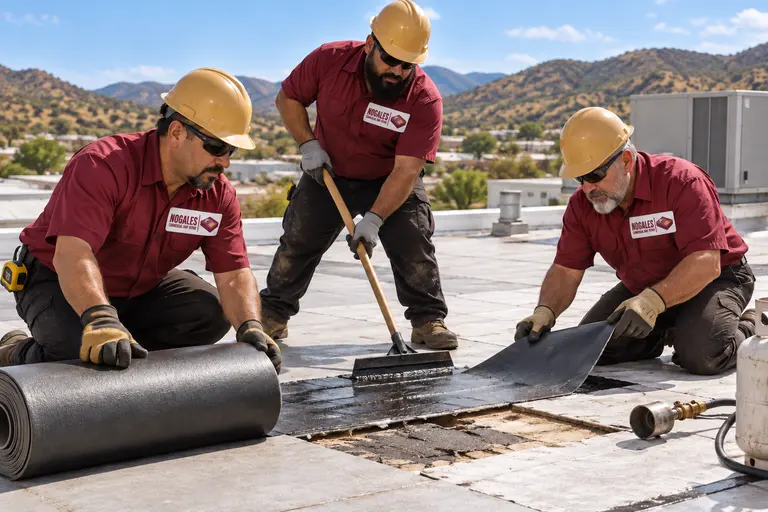
Membrane sections between equipment rows repair like any flat roof, at seams, drains, and parapets.
Repair membrane sectionsPlanning comes first. Before work starts, we map curbs and pipe penetrations that need new flashing, exhaust outlets where heat or residue softened the membrane, walkway routes, and work windows that fit shipping, receiving, and production. Heat or flame work near stacks is coordinated with your facility team.
A facility or maintenance contact who can stop a fan, open the roof hatch, and confirm work windows. On larger plants, a short walk with that person before work starts saves time later.
Sometimes. A fan blowing across the work area or a hot exhaust outlet needs to stop while its curb is flashed. We schedule that with your maintenance team in advance.
It depends on the heat and what the exhaust carries. We look at the softened area and the product on the roof, then pick a repair material rated for that exposure.
Yes. Pads along the routes technicians use to reach equipment protect the membrane where punctures keep coming back. We mark the routes with your maintenance team, so pads go where people actually walk between the hatch and each unit.
Yes. Open skylights and roof edges get guards or warning lines before work starts near them, and the work area is set up so crews stay clear of them.
Each curb or penetration is opened only when there is time to close it before weather arrives. During the monsoon we watch afternoon storm forecasts and keep cover material on the roof so any open area can be sealed quickly.
Yes. A roof plan showing each repaired curb, penetration, and walkway, with dated photos, helps your maintenance team track what was done.
Tell us about the equipment and the schedule. We plan the repair around both.
Leave a name and number and we will call you back about the leak, the seam, or the panel that has you worried.
Or call now: +1 (623) 310-0172