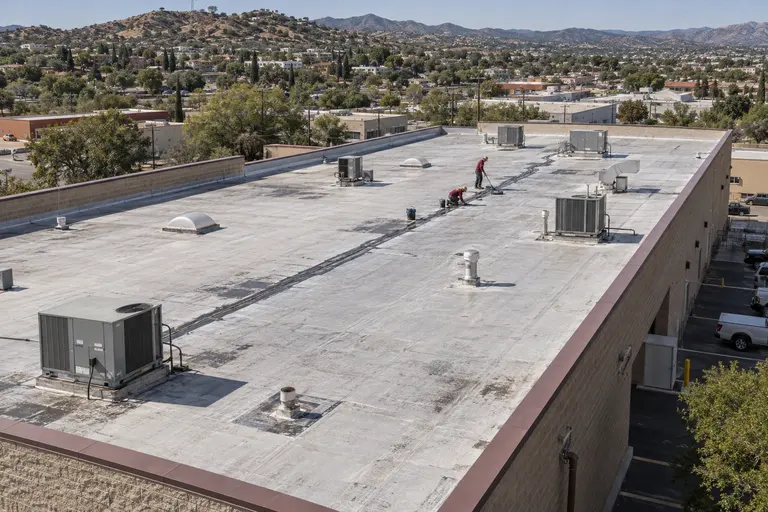
Flat Roof Repair
Most traced leaks on membrane roofs end at a seam, drain, or curb corner that a flat roof repair rebuilds.
Repair the flat roof detail
Commercial roof leak repair in Nogales starts at the ceiling stain and works up to the roof. We stop the water first, then repair the detail that let it in.

A leak repair works when the water enters at one detail. The tracing shows whether that is the case or whether more of the roof is failing.
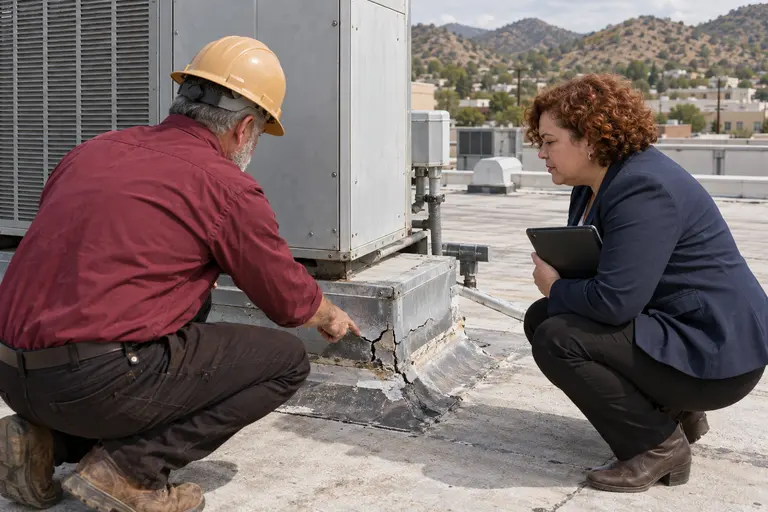
Water travels before it drips. These are the patterns we see most when a stain does not line up with anything on the roof.
Water entering at a curb or seam, then running along deck flutes until it reaches a low point.
Work upslope from the stain with a moisture meter until the readings lead to the opening.
A drain or scupper backing up, so water rises over a lap that stays dry in light rain.
Clear the outlet, then test that lap and reseal it before the next storm.
Insulation joints between roof boards soak up water and spread it sideways under the membrane.
Core cut to find the wet edge, remove soaked board, and close the opening above it.
A cracked pipe boot or pitch pan letting water follow the pipe straight into the building.
Replace the boot or refill the pitch pan, and flash it into the membrane.
A loose screw or lap several feet away feeds water along a purlin.
Trace along the purlin line on the roof and fix the screw or lap that feeds it.
Leak work happens in two stages: keep water out now, then make the lasting repair.
| Repair | What It Fixes | When It Is The Right Call |
|---|---|---|
| Temporary seal | Open seam or split flashing letting water in today | Rain is forecast or water is entering now |
| Drain clearing | Clogged drain or scupper backing water up | Water stands near an outlet after storms |
| Water test | Unclear entry point near several details | Readings point to more than one possible opening |
| Permanent repair | The failed seam, boot, curb, or lap | The roof is dry and the source is confirmed |
A leak stopped early costs a seam repair. One left running wets insulation, ceilings, and stock.
Wet tiles sag and fall. Stopping the leak early leaves the grid and tile in place for a simple swap.
Every storm through an open seam spreads water further along the insulation joints. Fast control limits the board that comes out.
Water dripping into a cold room freezes on racks and floors. A temporary seal at the condenser curb ends that until the repair.
Photos of the roof taken before the temporary seal show the damage as it was, which helps if you file a storm claim.
Tell us which room, how long it has been happening, and whether it follows rain. A temporary seal can go on before the permanent fix.
Inside and on the roof, each step narrows down where the water gets in. Inspect Your Roof always starts it.
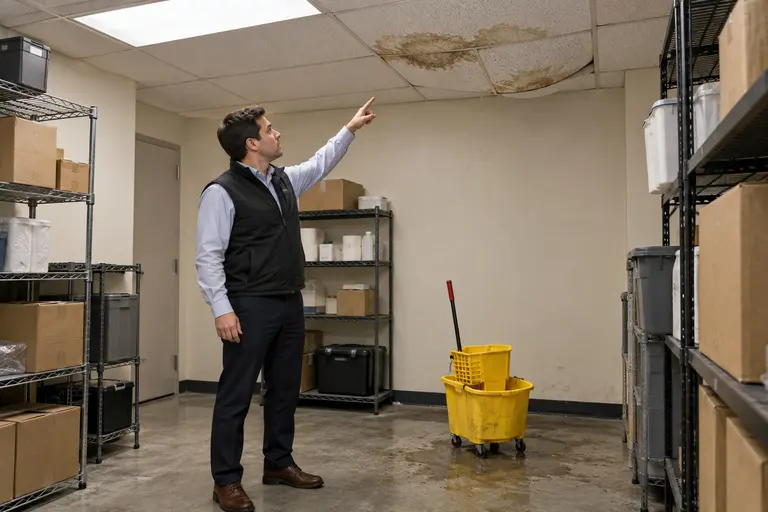

We check the roof above the stain first, then the curbs, drains, and seams upslope of it, and photograph each detail.
Stains, drips, and wet ceiling tiles get marked on a sketch of the building so the roof readings can be matched to them.
Moisture readings narrow the area; a controlled water test on a single seam or curb confirms the opening.
Tape, mastic, or a cleared drain stops water now; the permanent repair follows once that area of roof is dry.
The stain area gets checked after the next storm to confirm it stays dry, and replaced tiles can go back up.
Once the source is found, the repair usually falls under one of these services.
Most traced leaks on membrane roofs end at a seam, drain, or curb corner that a flat roof repair rebuilds.
Repair the flat roof detail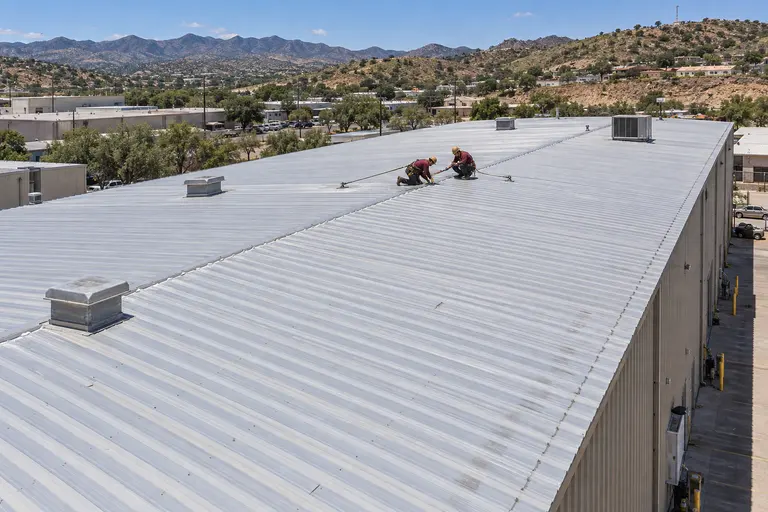
On steel buildings, the trace often leads to a loose screw or a dried end lap.
Repair metal screws and lapsWater gets in at a seam or flashing, then runs along deck flutes, insulation joints, or a purlin until it reaches a low point or a fastener hole. On a large Rio Rico warehouse, the stain can show up several bays away. We trace it from the stain upslope with moisture readings.
Yes, in most cases. Compatible tape or mastic over an open seam or split flashing, a cleared drain or scupper, or a cover on a cracked skylight panel keeps water out until the roof is dry and clean enough for a lasting repair.
Moisture readings narrow the wet area, and a controlled water test on one seam or curb at a time confirms the opening. Testing one detail at a time keeps the result clear.
Both. Protect stock and equipment under the drip, take dated photos of the stain, and call. The sooner the opening is sealed, the less insulation gets wet.
Yes. Cracked parapet coping, loose counterflashing, and failed scupper flashing let water in at the top of the wall, and it shows up along an outside wall inside.
That often points to a drain or scupper that backs up during heavy rain, letting water rise over a lap that stays dry in a light shower. Clearing the outlet is the first step.
Our work is the roof. Once the roof is dry and the stain stays dry after rain, your maintenance staff or interior contractor can replace the tiles with confidence.
Describe where the water shows up. We trace it and stop it.
Leave a name and number and we will call you back about the leak, the seam, or the panel that has you worried.
Or call now: +1 (623) 310-0172